


Artificial Intelligence (AI) and intellectual property evidence
Whilst it is clear that AI represents an opportunity and a step forward in many fields, the lack of control over its content means it can become a threat. The prevalence of fake news, often accompanied by false images generated by AI, is proof of this. Consequently, a particular question arises regarding the use of AI as evidence in legal proceedings.
A rejection of AI evidence
Indeed, there are numerous cases in which generative AI has been used as an argument or piece of evidence in court, with limited success. The current trend seems to be towards rejecting evidence derived from the use of AI.
For example, AI was used to establish Louboutin’s reputation in the field of men’s studded shoes. The Indian judge ruled that the tool (Chat GPT) was not sufficiently reliable as the responses were likely to be biased by the type of query (Louboutin v. the Shoe Shop). Consequently, reputation could not be based on an AI response attesting to it.
This mistrust of ChatGPT was also highlighted in the Pegnatori v. Pure Sport Technology decision in the US, which found, in particular, that a definition—in this case, ChatGPT’s definition of the term ‘foam’—was not sufficiently substantiated. Generally speaking, “ChatGPT’s success rate in legal briefs leaves much to be desired”. The same view is held by the EUIPO (Exagres v. Gres de Aragon), for whom the use of “ChatGPT means that results vary enormously depending on how questions are asked”.
A dedicated database
All these decisions are listed in a database created by Damien Charlotin, a lawyer and research associate at Sciences Po and HEC Paris; you can find them here.
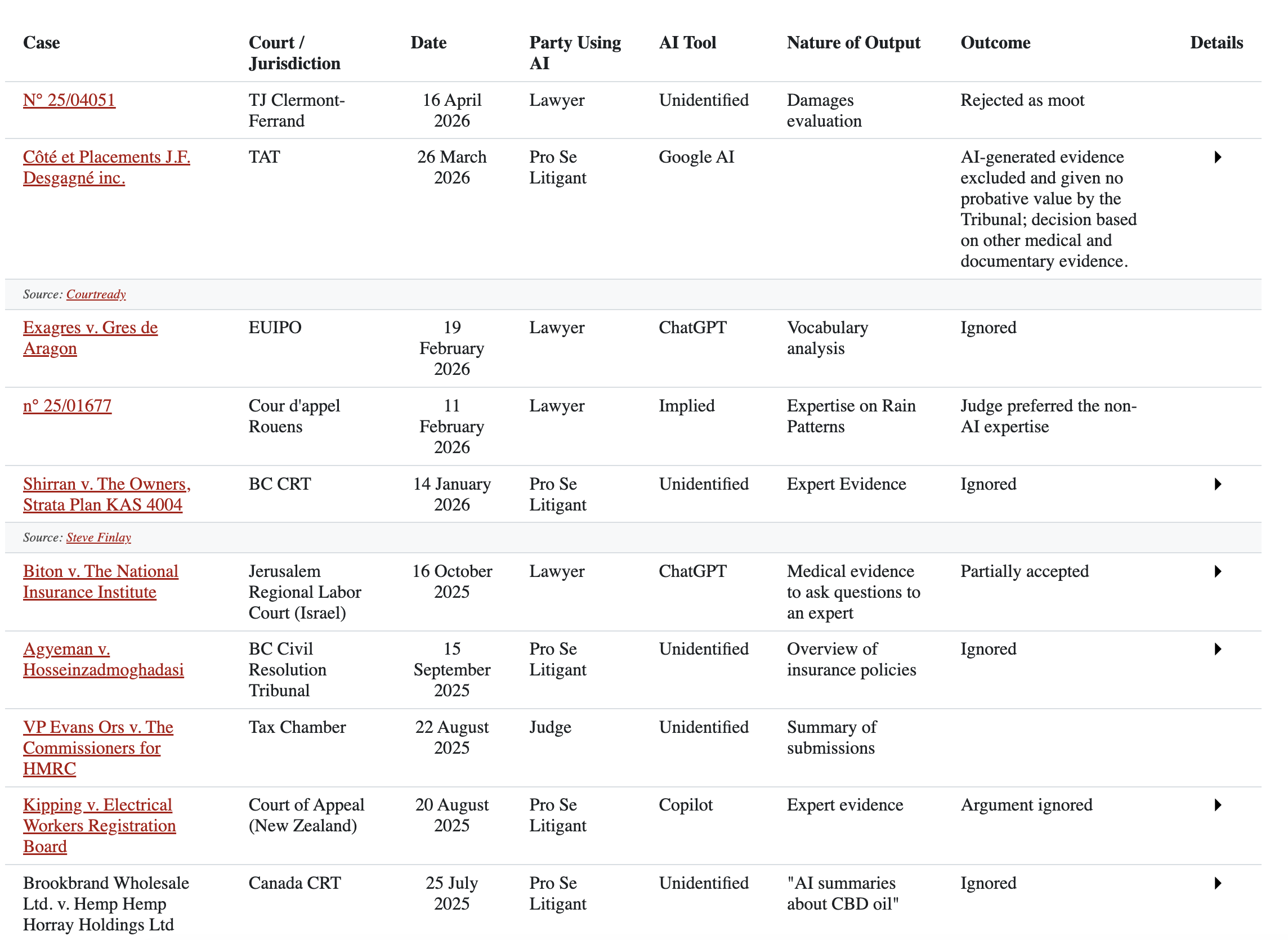
As specialists in evidence research, this is of particular concern to us. With generative AI, the arguments put forward by the opposing party must be verified and can be more easily challenged. Why? Because biased responses, as well as false evidence, are easy to create. Despite the efforts of search engines such as Google to protect the reliability of their results, professionals may unintentionally use false content found on the internet.
The importance of paper evidence
That is why, at Paperz IP, we have access to reliable sources and take care to verify any questionable sources. Far be it from us to do without AI; we use it daily both to save time within our own archives and to carry out an initial screening of online searches. But this use is subject to rigorous control: we time-stamp and protect our digital sources using blockchain technology, and if there is any doubt about a source, we naturally inform our clients.
Find out more about the use of AI in documentary research here.
In any case, it is clear that paper-based evidence, such as the tens of thousands of documents (books, magazines, commercial catalogues) that we hold in our archives, is not subject to this uncertainty and will no doubt be increasingly valued as a form of evidence in the future.

We are at your disposal to assist with your needs regarding the research of evidence relating to designs (prior art) and trademarks (evidence of use and reputation) !